
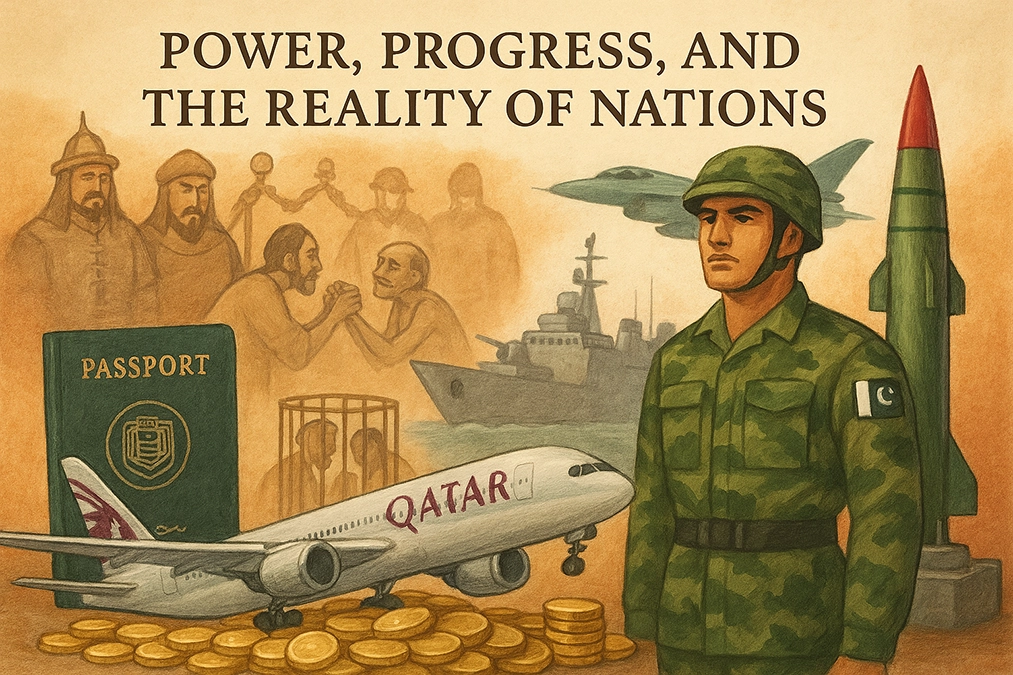
Among the world’s leading airlines, Qatar Airways ranks at the top. Similarly, the passport of the United Arab Emirates is considered one of the most powerful in the world, granting visa-free access to 136 countries and visa-on-arrival access to 46 more.
However, one must reflect: true power in the world belongs to nations that possess strategic and military strength. In this regard, Pakistan, as a nuclear power, holds a unique position.
History offers us a powerful lesson. When the Mongols destroyed Baghdad and captured its rulers, imprisoning them in cages, those rulers—starving and desperate—begged for food and water. Instead, the Mongols placed gold and silver before them. The rulers wept and said, “How can we eat this?” The Mongols replied, “If you could not eat it and it served you no real purpose, why did you accumulate it? Now, consume it and satisfy your hunger with it.”
This historical episode resonates deeply when we observe the modern world. One might ask: can economic achievements alone ensure survival or dignity? Can a powerful passport or a globally renowned airline protect a nation in times of crisis?
This is not to suggest that economic development or progress is undesirable. On the contrary, growth and development are essential. However, the reality remains that without strong defense capabilities—without a robust army, air force, and navy—even the strongest economies can collapse within days. A nation that cannot defend itself remains vulnerable, regardless of its economic standing.
When we look at Pakistan through this lens, there is reason for gratitude. It is true that Pakistan’s passport is relatively weak, the economy faces serious challenges, and political instability persists. Yet it is equally true Pakistan also possesses a highly professional and capable military. Its armed forces, including the air force and navy, have demonstrated the ability to defend against significantly larger adversaries. Moreover, its nuclear capability serves as a powerful deterrent.
In a world where nations are constantly strategizing to secure resources and protect their interests, strength—particularly defensive strength—remains a defining factor. History shows us that the decline of nations is not always due to economic weakness; often, it is the result of compromised defense and the loss of strategic capability.
If a nation survives, it can rebuild its economy. But if it falls into chaos as seen recently in Yemen, Syria, Iraq, Libya, or Sudan, then even the possibility of economic recovery becomes distant.
The truth is simple: the world ultimately remembers nations not merely for their economic achievements but for their strength—their ability to protect themselves and assert their sovereignty.